 East Texas Canids
Conflicting Canids: Re-examining the Smith-Cherokee “War on Wolves,” 1961-1966.
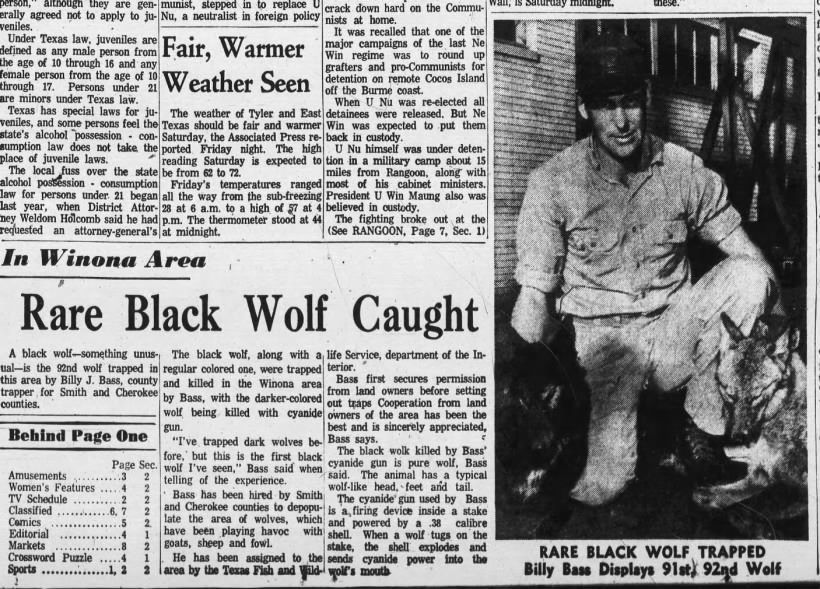
“Rare Black Wolf Caught,” Tyler Morning Telegraph, Saturday, March 3, 1962, Newspapers.com.
“I’ve trapped dark wolves before, but this is the first black wolf I’ve seen,” said Billy Bass, county trapper for both Smith and Cherokee counties. Bass went on in an interview to specify that his ninety-second catch was “pure wolf… The animal has a typical wolf-like head, feet and tail.”1 In 1962, this was an important, and rare, distinction. So rare, in fact, that it was photographed for the front page of the Tyler Morning Telegraph alongside headlines like, “U.S. Atmosphere Tests Depend on Soviet Pact” and “U.S. Running to Moon Says LBJ.” The photograph shows Bass down on one knee, lifting two dead canids - the catch-all term for the scientific family of dogs, wolves, coyotes, and foxes - by the scruff of their necks to better display their heads and chests. It is assumed that because the rare black canid was his ninety-second catch, the other “regular colored one” was his ninety-first. No genders or approximate ages are listed for these animals, leaving no clues as to their relationship or possible lives. However, it is known that they were trapped near Winona, a small town less than four miles from the dense bottomlands of the Sabine River, which functioned as the Smith County line and thus the northern limit of Bass’s jurisdiction. He was not responsible for problem animals reported on the north side of the river in Wood, Upshur, or Gregg counties - those would be left to their county trapper, if the residents chose to employ one at all that year. The ultimate fate of the remains of these two animals is unknown.
The idea of a “government trapper,” who’s salary was paid jointly by federal, state, and county taxes, invading people’s private property and setting lethal, indiscriminate cyanide gun traps, was contentious in Cold War East Texas. The reasons for this contention were varied. Annual budgetary constraints often affected the decision and some counties opted to handle their problems themselves, with Cherokee County offering $15 per head in 1960.1 Many people were concerned for the population of game foxes and/or the wellbeing of their own free-roaming dogs, both of which were equally susceptible to the “uncomparable[sic]” stench of the bait, described as a “pasty mixture of putrified[sic] meats, artificial musk, and ground dried beaver glands.”2 This bait was applied (with gloves!) to a trigger mechanism which fired a 38-caliber round dosed with cyanide into the mouth of indiscriminate animals. Even overly curious cows could fall prey to these traps. Bass’s black wolf was killed via cyanide gun, while the other animal was caught with a traditional steel trap. Catching these predators was smelly, dirty work, and for the specialized trapper hired jointly by Smith and Cherokee counties between 1961 and 1966, long hours were spent driving between affected farms scattered across nearly 2,000 square miles, running the interior of three vast river systems – the Angelina, the Neches, and the Sabine. This paper argues that the dynamic complexities of the local environment, both geographic and human, directly impacted red wolf extirpation efforts in the area, creating an inefficient and ineffective predator control program for those critical years in red wolf history, potentially allowing for an unusual survival of genetics in the region. The species scientists now refer to as Canis rufus was known for many years as Canis niger, with Canis rufus’ modern designation as a unique species continuing to be challenged by the undereducated and politically-motivated populations, though the two perspectives are not necessarily mutually exclusive. Taxonomic confusion and misconceptions surrounding the population status of the red wolf plagued biologists working to understand the species and its relationship to other canids throughout the Cold War, not only historically but colloquially, with many humans commonly identifying wolves, coyotes, and varying types of hybrids under the “wolf” umbrella well into the 1980s. In 1961, the most efficient method of examining this problem was to measure and chart the skull sizes of animals killed within the red wolf’s historic range. Howard McCarley, a founding father of modern red wolf study, details this process in his short paper titled, “The Taxonomic Status of Wild Canis (Canidae) in the South Central United States,” published in December 1962. While acknowledging historic wolf populations, McCarley’s measurements indicated that coyotes had fully invaded red wolf territory and that ultimately “all the wild Canis currently occurring in Arkansas… Oklahoma, and Texas are referable to C. latrans frustrator [coyote].” He explains this replacement phenomenon with the “hybrid swarm” theory, saying, “As the coyote populations continued to expand eastward, hybridization increased, gradually swamping out the red wolf populations as the previously effective isolation mechanisms (geographic, ecological?) broke down. The population sample of recent Canis with the largest skull dimensions came from the eastern counties of Oklahoma, presumably the last portion of Oklahoma to be extensively influenced by the activities of man.”3 This research assumes that by “activities of man,” McCarley meant intensive Anglo-American-style agricultural systems. As far as biologists were concerned, the upper Sabine, Neches, and Angelinas were lost causes in the search for any remaining “true” wolves – all recent specimens examined came up coyote. Somewhat ironically, biologists would subsequently focus their research along the lower portions of those same rivers in Louisiana and southeastern Texas, though the area was settled by encroaching Anglo-Americans comparatively early in the region’s history. Perhaps a more nuanced interpretation is that a belt of human settlement cut through the center of the river systems, potentially fracturing and isolating red wolf populations, but not necessarily dominating the uppermost and lowermost points of those systems.
Though it is not disputed that the large majority of canids surveyed in this area were coyotes or hybrids at best, McCarley’s data set was fundamentally limited by its methodology and the sourcing of skulls. This research does not necessarily seek to question McCarley’s interpretation of the data, but rather his access to truly representative regional specimens. Simply put, McCarley’s study was limited to dead animals with relatively clear histories tied to their collection, as well as his observation of miles of rural fencelines draped with coyote carcasses left by predator control specialists and dead-animal enthusiasts, which he reported to be a common sight in eastern Texas. Addressing the problem of specimen collection, McCarley says, “Admittedly, this available evidence which discounts current reports of red wolves from the areas is of a negative nature, but it seems likely that if animals large enough to be considered red wolves currently existed in the areas, at least some recent specimen would have been available.”4 Critically, though his research was published in December of 1962, McCarley’s data was collected in 1961. It is unclear whether McCarley or any other researchers were made aware of Bass’s “rare black” and “regular colored” canids caught in the spring of 1962, or any later large specimens which occasionally dotted local newspaper reports. However, if they had been studied and the morphology of these animals had classified them as hybrids, it is unlikely that their presence in the record would have made a difference to the species’ historic trajectory. During this period, hybrids were also lost causes to be abandoned early in the efforts to conserve the true wolves.
Further, McCarley’s own question of why the naturally occurring “effective isolation mechanisms” broke down, whether geographic or ecological, is increasingly better understood by modern biologists and environmental historians, especially when data and techniques from both fields are utilized cooperatively and comparatively. Though he notes that the largest skulls ame from eastern Oklahoma, “presumably” the last area of the state to be “extensively influenced,” by Anglo-American settlement, it is also worth noting that Smith County and the surrounding area was among the last red wolf habitat settled by Anglo-Americans in Texas as immigrant groups of Cherokee, Delaware, and Alabama-Coushatta peoples - among many others loosely organized under the leadership of the Cherokee Chief Bowles - remained politically and economically dominant in the upper regions of East Texas’s rivers until July 16, 1839, when the community experienced a decisive military defeat and subsequent massacre at the hands of the Texan Army. Loosely bound by our three rivers, the former Cherokee territory was formally divided by the Anglo government in 1846, at which point Smith and Cherokee counties were created, with cities intentionally planned near the geographic center of the counties and away from the rivers which make up their borders. Perhaps because the rivers in this area were not consistently or economically navigable, or because they did not need to be navigable after certain economic dynamics changed and overland transportation routes improved, surrounding counties typically experienced a similar spatial trajectory. Thus, the counties encompassing the headwaters regions remained relatively sparsely populated for generations, especially in comparison to denser human settlements and activity encroaching on historic habitat downriver. Considering the blurry ecological histories of both coyotes and red wolves in Smith County, likely due to its unique pocket of Post-Oak Savannah introgression, one may question whether the ecological barriers between the two species were ever fully broken down in this region, or conversely, whether the barriers were ever distinct in the first place.
Geographically and informationally, this study will be centered in Smith and Cherokee counties. However, because it is now understood that red wolves prefer wetlands and riverine systems, it will broadly focus on an inverted, slightly misshapen and definitely fractured “golden triangle” of potential historic habitat, encompassing the headwaters and upper sections the Sabine, the Angelina, and the Neches rivers, which generously provide the boundaries of roughly thirteen counties in this context. This case study will not examine dynamics further down the river systems and focuses primarily on the area roughly southwest of Longview flowing sixty miles down into the Angelina to Alto, then north up the Neches about ninety miles towards Lake Tawakoni, and from there a crow’s fly of sixty miles down the Sabine back to Longview. Roughly. (All aerial direct miles because the rivers aren’t especially navigable in these here parts.) While the lower majority of these river systems reside in the Piney Woods ecoregion, infamous for its historic lumbering and red wolf habitat destruction, the headwaters tend to stretch out here, scattering springs and deep streams into the Post Oak Savannah ecoregion, famous for its park-like prairies dotted with shade trees. Historically, coyotes tend to prefer the open prairie habitat, while red wolves, sometimes identified as “timber wolves,” were more commonly found deep in the dark mixed forests surrounding the rivers. Humans clustered around the iron-rich springs and creeks, though they often smelled of sulfur.5 Smith County is unique in that it perfectly represents this fuzzy ecological meeting point, with a pocket of Post Oak Savannah pouring between the Sabine and Neches to fill roughly two-thirds of the county, essentially creating a keyhole of coyote habitat with the interior expanded by human introgression over the years. It is unknown how long the wolves managed to hide this territory from the coyotes, or if they ever even tried very hard. Because this specific ecoregion “boundary” has become indistinct locally, with pine trees and prairies sharing fencelines in rural areas throughout the county - and both parcels often ecologically connected by a brushy creek - an extremely dynamic economic system has developed as it relates to canid habitat. As such, considering the economic and environmental systems together and analyzing the headwaters systems as whole, instead of examining a single county or even single river, provides a much more nuanced view of the predator control programs and the broader environmental attitudes and conditions along these dynamic and diverse rivers, revealing distinct differences in management, perception, and visibility of the species across county lines during this critical period of their history.
Two significant economic and environmental circumstances predicated the uptick in human-canid conflict seen in the late 1950s and early 1960s. First, and perhaps most importantly, the discovery and development of the East Texas Oil Field in the 1930s drove massive human migration away from the upper Sabine and Neches towards the booming cities of Longview, Tyler, and Kilgore, decreasing the population density dramatically for miles along portions of the river systems, turning many small rural communities into ghost towns surrounded by unmanaged land. However, Gregg County is an important exception to this, and it should be emphasized that the oil boom and subsequent growth of Longview and Kilgore destabilized critical red wolf habitat along the Sabine and upper Angelina, likely impacting their historic movement along the rivers and creeks. While Smith and Gregg counties saw consistent human population gains from 1930 to 1960, the peripheral counties consistently reported significant population decreases during these years, as demonstrated by Table 1. It must be emphasized that these population gains were concentrated around the centrally-located cities and satellite towns, and that even the net gains in Smith County during this period generally reflect migration out of rural areas along the rivers. Though many of these counties were finally reversing the downward trend by the 1960 census, proximity to the “major” cities of Tyler and Longview remained the driver for much of this growth. The peripheral Rains County represents a microcosm of this rural outmigration, with the Texas State Historical Association noting that by 1959, the county’s population statistics had essentially reverted back to the 1880s, with land use reflecting comparable patterns.6 By 1960, the county counted 2,993 residents, of which nearly 1,000 were divided between the main towns of Emory and Point. Deducting this “urban” population and the five square miles of the towns from the total area of the diminutive county pushes the 1960 Rains County population density to nearly eight people per square mile, without factoring in the densities of the smaller communities, all steadily losing their hyper-local country schoolhouses. Extreme though it may seem, this was not an unusual dynamic along these upper river systems. Rains, Cherokee, and Houston counties still had not recovered their pre-oil boom human populations by the end of the Cold War. Even today much of the land surrounding the river bottoms remains sparsely populated and densely forested.
The second most important environmental pattern occurred between 1948 and 1980, when nine large dam construction projects flooded roughly 109,000 acres of historic red wolf habitat in the study area, as displayed in Table 2.7 Historic drought conditions parched the state throughout the 1950s, driving the construction of new lakes and reservoirs to mitigate future water shortages and to support increasing urban populations. This period of major drought would also impact the ecological system up and down the food chain, though Northeast Texas fared relatively well through these years thanks to the area’s high water table and the occasional relieving shower. As the drought subsided in the late 50s, years-long dam construction projects resulted in the inundation of Lake Tawakoni in 1960 and Lake Palestine in 1962, significantly impacting canid habitat along the Sabine and Neches, respectively. It is also worth noting that the population of the town of Chandler, just across the river in Henderson County, almost doubled after the completion of Lake Palestine, boasting 715 residents in 1960 and booming to 1,308 in 1980, an additional pressure on the immediate riverine habitat.8 Despite this, roughly ten direct miles of the Neches headwaters ecosystem remained above the northernmost point of Lake Palestine. Thanks to the advent of aerial photography in the 1930s, and the advent of the internet in the 1990s, dedicated (or just plain obsessive) researchers may examine the river systems and their changes through the years from source to mouth.9
To translate these environmental changes on the ground into the human perspective, this study utilizes both contemporaneous local newspapers and later scientific studies to interpret historic data and popular perception regarding the species. Simply put, though the Smith-Cherokee County “wolf trapper” and civilians in the 1960s did sometimes trap animals suspiciously similar to red wolves, it is more likely that their time was spent trapping coyotes or canids with varying degrees of wolf-coyote or (x)-dog hybridity. The fundamental question is why that was, and whether Howard McCarley actually had the opportunity to procure a dataset truly representative of the local red wolf habitat or if the area’s source material was skewed to represent Smith County’s pocket of coyote habitat. Colloquial usage of the term “wolf” certainly adds complexities to this analysis, but part of the puzzle is when and how the region’s canids morphed from wolves to hybrids to coyotes within the public perception, much the same way the “wolf trapper” becomes “predator control.” Over time, cultural pressure from the scientific community forced a regional linguistic switch which pushed identification of local canids under the coyote umbrella regardless of size, and wolves fade from view in the regional historical record. Technically, without definitive scientific evidence like skulls, measurements, or genetic samples, this researcher cannot definitively determine the true nature of this area’s canids, historic or contemporary. However, distinctions in things like weight, behavior, or location do appear and can provide clues to untangling this language barrier and can potentially help restore a small piece of the species’ obscured history. Though scattered information from newspaper reports is not necessarily a reliable marker for the presence of true wolves, this study will highlight any “non-standard” canids encountered, with coyotes being treated as the standard. Admittedly, this researcher functions from a place of potentially debilitating optimism regarding this subject, and most optimistically this research points to the presence of at least something unusual lurking in the area’s gene pool long after McCarley’s assertion that nothing of biological value was left of the species. So, what were the locals so afraid of?
By the 1960s, due to the public’s concern regarding the locations of both the “wolves” and the government-owned lethal traps, a short report on the trapper’s efforts was typically published once per week by the Smith County Agricultural Extension Agent (Ag Agent) in the Tyler Morning Telegraph, providing key data for locations and number of kills per week, as well as insights into attitudes and perceptions surrounding canids. Beyond the “wolf” data, these reports typically reveal general goings-on in the county and various land-owner’s successes and failures in their various agricultural endeavors, providing glimpses into peripheral issues of local land management and education, including the latest in scientific agricultural innovation and efforts at public communication. The development of hay fields, reports of rabies transmissions, calls for kudzu shoots, and the dangers of screwworm are frequently found in the column alongside the competitive successes of the local youth 4-H chapters and community problem-solving efforts (also somewhat competitive). At least from the perspective of the State and County, Texas’s agricultural programs needed well-educated, cooperative property owners to maintain its competitive economic position within this rapidly changing, often frightening, era. As such, leadership in Texas exhibited few qualms about enlisting the help of the Almighty for the cause, emphasizing a moral imperative of land stewardship through the Agricultural Extension system. For example, during 1965’s Soil Stewardship Week (May 19-26), the Ag Agent’s weekly column noted that some churches in the state planned themed sermons, and that “[s]oil conservation tours and other means will be used to remind Texans of their responsibilities to God and to society to conserve and use wisely our resources.”10
The study of Texas frequently presents ironies and paradoxes, especially around its land use. Though advocating for at least some level of environmental sustainability, Texans continue playing whack-a-mole with problems created by the state’s predominately Anglo-American forebearers’ lack of understanding of environmental systems, which historically promoted practices of extractionism and introduction of colonizing invasives like kudzu in some areas while simultaneously uplifting an appreciation for the state’s profound natural beauty in others. These sorts of paradoxes can be internalized down to a personal level, and the breadth of those attitudes can be seen in this case study and better understood through a generational framework. After World War I and II, many Texans benefited from federal initiatives which set higher standards for public education, resource management, and long-term economic development across the country, allowing the United States to grow and maintain its global position against the Soviet threat. Even in Texas, both the Silent Generation and Baby Boomers were increasingly educated in a globally competitive public school system, which encouraged continued studies in institutions like Texas A&M and the University of Texas. For those leaving rural East Texas for that purpose, the next question was often whether to return home with that education or to remain in the bustling urban areas with better infrastructure and diverse employment opportunities. Whatever individuals decided, over a generation or so, these nationwide educational initiatives and the questions they produced, as well as an increasingly intertwined global economic system and the continued U.S. involvement in overseas wars, allowed for significant shifts in public perception and engagement with government policy, culminating in waves of national civil rights and environmental protection legislation beginning in the mid-1960s. No matter what Texans believed then or believe now, the state was not exceptional in this regard.
However, Texas does have a long, exceptional history of relatively early adoption of environmental protections and regulations for fish, birds, and game animals to maintain their economic viability at the very least. Further, the local oil boom mitigated some of the worst economic effects of the Great Depression in the area, decreasing the necessity of subsistence hunting and thus insulating game populations for both humans and canids and simultaneously decreasing human-wildlife conflict in the area overall for decades. By the late 1940s and 50s, a growing consumerist middle class with decreased reliance on subsistence land use allowed for the development of an early conservation movement in the form of public and sport hunting culture in the region, specifically among the state’s white, male middle- and upper-class population. While some in Smith County’s black community fought for access to public fishing space at Tyler State Park throughout the 1940s, long-standing segregation policies in the region pushed many non-white residents away from the best public hunting lands, and the permitting system posed another barrier to these economically suppressed communities.11 Even today, hunting remains a white-dominated “sport,” and further research is needed into the racial dynamics surrounding the utilization of trapping services in the region.
The state’s sparse public lands are both a boon and a handicap to this study, with the vast majority of habitat being under private ownership, though some sections of the upper Sabine are managed as federal, state, and local conservation spaces. However, over time, the private ownership system has created a patchwork of potential habitat for both coyotes and red wolves. While some citizens opted to get their agricultural tax exemption from cattle or hay production, their neighbor may have chosen the straight stands of a pine plantation. Their children might have made inverse choices on the same parcels of land, or sold it to someone who wanted to chop down the peach trees to get in on the blooming rose industry, a famously lucrative and reliable piece of local beautification propaganda for the upper human crust of Tyler. An individual or family’s socio-economic position, education, and oftentimes personal connection to the landscape impacted all of these decisions. However, in some places the rural outmigration of the 1930s-50s left parcels untended for generations, resulting in increasingly dense forests of colonizing sweetgum, privet, blackberry briars, native plums, holly, and other brushy undergrowth suitable as both deer browse and canid cover. Albeit highly conditional and unintentional, these massive shifts in the human population, viewed both collectively and individually, resulted in a local habitat which increasingly supported both prey and predator populations during critical years of red wolf history. In addition, though their diets overlap and though both species will adjust their diet in times of scarcity, red wolves typically consume more deer while coyotes generally prefer smaller mammals. Both species will utilize fruit and berries, crops which have coincidentally been significant contributors to the local agricultural economy for many years. Overall, the region supported an abundance of deer, racoons, rabbits, rodents, sweet potatoes, and fruit, especially in the form of peaches, which grow well in the county’s sandier soils. According to one Bullard resident in 1957, apparently even watermelons were susceptible to canid depredations, though he was more concerned about what would happen once the animals ran out of watermelons than the destruction of the crop itself.12 With all this activity in the “golden triangle,” its no wonder the locals were crying wolf - they were inadvertently bolstering and supplying the enemy canid forces for years.
Regardless of which species was doing the depredating, the county trapper could be called in to deal with the problem animals. As the most hands-on sources for this research, the trappers were clearly well aware of the differences in the animals they encountered and would occasionally make a distinction in their reports if a “timber,” “pure,” or “true” wolf was captured. It is important to remember that though the local parlance might not fully align with contemporaneous scientific taxonomy, both were in flux during this period – everyone was having a hard time drawing lines around these animals. Critters approaching true wolf territory were rarely caught, with 1950s Smith County trapper C.C. Dixon preferring old-school steel traps over modern stink bait and cyanide, asserting “You can kill some of the young wolves with the cyanide, but the old wise ones merely show their contempt for the chemical guns – sometimes in a most humiliating fashion.”13
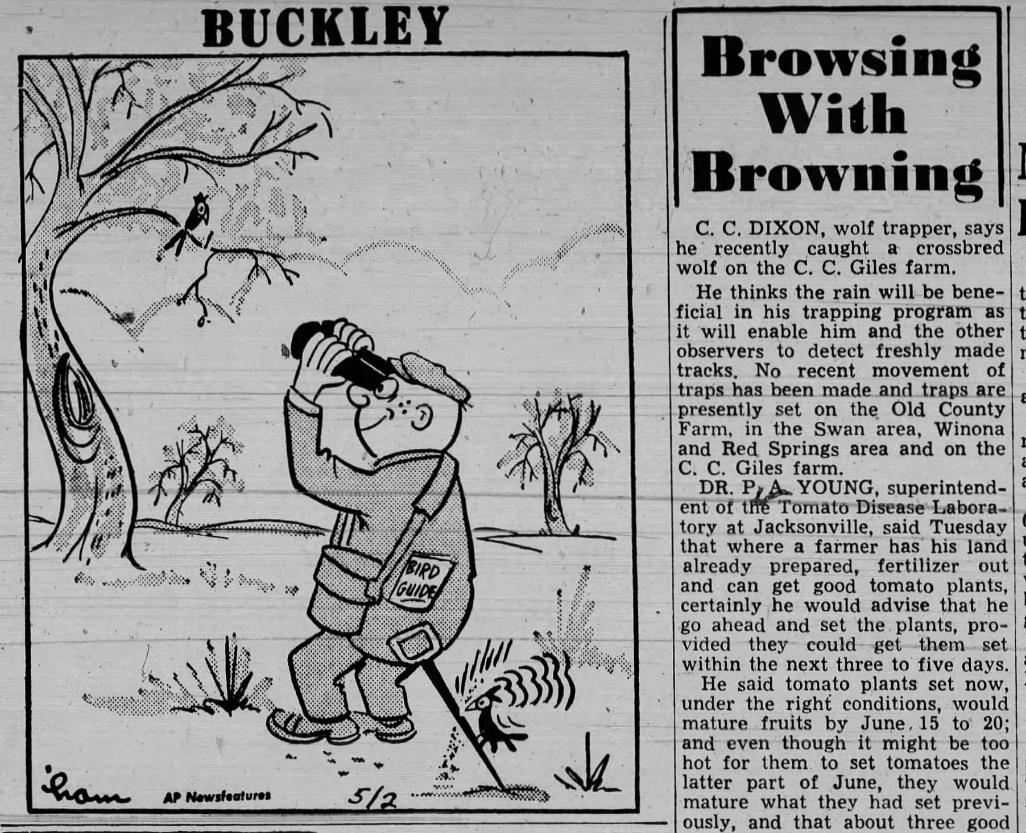
Typical “Browsing with Browning” column by Smith County Ag Agent Ben Browning, 1956.
Only a few humans were willing to tolerate such humiliations personally, and in counties with a trapper in place instead of a bounty system, the animals were effectively worthless to most residents. Canid trapping was no sport for amateur hunters, either. Facing extremely efficient and elusive apex predators, wily coyotes, and everything in between, ranchers experiencing depredations were typically unable to control the problem on their own. It is important to remember that these specialist trappers were hired to control depredations at specific farms and ranches, not to police an entire species, though some humans and the program as a whole may have certainly had that desire. The question then becomes whether these individual trappers would have had the time, the resources, or the wits to truly extirpate the red wolf locally, especially when so much time was devoted to trapping a clearly booming coyote, or technically at best hybrid, population.
Initially specifically concerned by “the growing wolf menace” along Mud Creek, a tributary of the Angelina which runs through southeastern Smith and northern Cherokee counties, in 1961 it made some sense to hire a single trapper, Billy Bass, to champion both counties in the “War on Wolves,” economically and geographically.14 The two counties had never before banded together in this war, with Cherokee County hiring trapper John C. Estes in 1958 and 1959 but opting for a bounty system in 1960, and Smith County consistently employing C.C. Dixon as trapper for several years previously. In addition, in February of 1959, the community of Sabine reported a case of rabies in the northwestern corner of Smith County, resulting in a community-led and Dixon-supported mass poisoning event focused on depopulating foxes.15 The exact scale of this poisoning event is unknown, with reports fluctuating between 7,000 -12,000 acres “sited to cover an 8-mile strip” of the community’s namesake river bottoms, and with relative success ultimately dependent on individual property owner participation and competence.16 Though this may have temporarily relieved depredations along the northern border, Dixon’s move to Rusk County in May of 1960 left Smith County trapper-less for ten months.
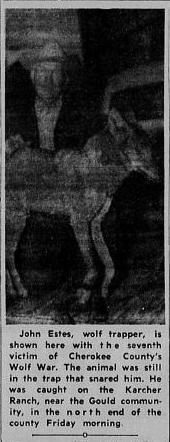
Trapper John Estes, Gould Area, Cherokee County, 1958.
Though economically well-off, Smith County’s decision to hire a new trapper was still influenced by budgetary constraints, especially as the county focused on large-scale construction projects like Interstate 20 and other roadway improvements. In addition, after the 1960 presidential election placed Senator Lyndon B. Johnson in the position of Vice President, the expenses for the special senatorial election held to fill Johnson’s vacancy threatened to consume the wolf trapping budget. One newspaper reported that “[s]ome $5,000 to $6,000 over the planned budget,” would have to be spent on the election, noting other “proposed items will make the budget tightening extremely difficult – the right-of-way purchase program to begin late this year and the hiring of a wolf trapper…”17 Perhaps lingering resentment pushed a slim majority of Smith County voters to choose Barry Goldwater over LBJ in the 1964 presidential election, an atypical choice in Texas that year as far as final voting tallies go. Interestingly, Gregg and Panola counties, with the Sabine cutting straight through them, were also local outliers in this round of voting – all other surrounding counties voted for LBJ, including Cherokee.
While both counties contain portions of the East Texas Oil field, Smith County benefitted much more from the boom, and by 1961 the two counties had significant economic differences. With 130 more square miles and a population roughly one-third that of Smith, Cherokee County’s much smaller tax base historically relied on iron ore and timber production, with manufacturing industries and the Rusk State Hospital making up the less-extractive part of the economy (from a certain angle). Many residents continued growing fruits and vegetables and grazing cattle, but in the 1961 Declaration of War on Wolves, Cherokee County Commissioners expressed concern that “idle land in the county… has contributed to the growing wolf population which preys on livestock.” They asserted, “The problem will get worse.”18 Thus, with wolves at the door, the decision to hire a trapper was only made after outcry from residents across the county line, and the usual $3,000 salary contribution from the county was split evenly between the two county budgets.19
However, the trapper was not allowed to remain focused on Mud Creek for long. Calls for predator control were coming from Lindale before Bass was formally employed on April 1. Though his trapping program began south of Tyler, by April 15 he was visiting four farms near Winona, though the report notes that three farms in Starrville were experiencing “actual losses” and required the use of poison.20 By the end of that month, Bass was trapping throughout rural Smith County, but particularly near communities bordering the Sabine and Neches rivers. Interestingly, likely due to the increased chance of killing unintended targets and generating local animosity, Bass exhibited an initial reluctance to use the cyanide gun mechanism, reporting in August that due to the loss of “several hundred goats and pigs,” he was “being forced to poison to control a bunch of wolves doing extensive damage” to Horace Grissom’s and Afton Thrash’s farms, locations unknown.21
Trapping near the Sabine in November of 1961, Bass reported “thinning the wolves down on the Keleam farm” and taking “one big male wolf on the O.Y. Null farm in the Red Springs community,” but warned that the animals southwest of Bullard and at the Keleam farm southeast of Arp were “highly educated.”22 At some point later that month, either opportunistic or altruistic locals removed three traps, one in Red Springs and two near Arp. Though Bass called for the return of the federally-owned traps in the paper, their fate has not appeared in this research. This reveals another notable facet of this work: funding for equipment and bait was distributed bureaucratically, a critical limitation to effectively waging war in any circumstance, especially in areas with varying degrees of distrust of anything “government.” In addition, it is clear that sentiments surrounding the presence of these traps were varied on a highly localized level, indicating that at least some citizens were less inclined to utilize the services of the government trapper.
By January 10, 1962, Bass reported that “he had caught 60 wolves in Smith County in the nine months worked.” Though he was getting “splendid cooperation from land owners in every section of the country,” Bass stated that he was “just sorry I can’t get to every place that reports seeing a wolf and that sometimes I can’t catch the wolves.” Still, County Judge Harry Loftis congratulated Bass on his work, telling the trapper, “You have done better than I expected.”23 Only one non-standard “wolf” was found in 1961 in this research: the “big male” trapped near Red Springs in late November.
Photographs of the golden triangle’s canids are especially valuable in this research and rare in local newspapers, though interpreting them is akin to examining blurry evidence of Bigfoot. These photographs typically reveal at least one non-standard canid and are often helpfully accompanied by additional information regarding morphology, behavior, and/or location. This author suspects that coyotes tend to appear by volume in photographs, such as especially large litters found or a hunter killing several animals in a pack. Thus, the 1962 photograph of Bass’s “rare black wolf” and its “regular colored” companion are exemplary in this research. Unfortunately, the accompanying article provides few other clues regarding their histories, though it is known that two days later, the newspaper reported Bass trapping one wolf each on the C.B. Starnes Farm in Winona and the nearby Hale Farm at Red Springs. Interestingly, research from modern canid biologists and geneticists indicates that coyotes did not historically exhibit melanism until the species hybridized with dogs and wolves, though the exact timeline of the species genetic mixing is still unclear. It has also been found that melanistic canids not only tend to live longer, but they tend to select the darker, more humid habitat along the river systems than their “regular colored” canid littermates, more along the lines of red wolf behavior.24 Though some wild dogs are interspersed in the Ag Agent’s reports, this research only found one other relevant non-standard report during 1962: one “big wolf” was caught on the B.R. Patterson Farm, location unknown, the second week of April.25
Fortunately for Bass, such successes in the field earned him a promotion, and in 1963 Marshall Freeman was hired to fill the position, becoming responsible for the two counties alone until 1967. Residents of Cherokee County initially had mixed emotions about the wolf trapper’s presence, briefly fracturing the county trapping system due to a “delegation of eight” residents opposed to the trapper’s presence due to the danger to their dogs and “that as wolves have not killed calves in that area, there is little need for the trapper.”26 These deliberations reveal some of the attitudes and policies at work in this system of predator management, with another article noting that the southern delegation was also concerned about the impact on fox hunting. In early October, the delegation agreed to deal with any problem animals themselves, though 264 of their northern compatriots expressed enough concern to maintain trapping above Highway 84.27
However, within two weeks, the southern delegation presented a new petition with 261 signatures requesting reinstatement of Freeman’s original territory. Freeman was present at the meeting, and a representative from the Department of the Interior, John C. White, was also in attendance all the way from the district office in Fort Worth. White took the opportunity to explain the process of trapping operations, including the necessity of signatures in triplicate, and the various methods of keeping the community well-informed about potential dangers from the traps, as well as noting the fact that “only a small percentage of the wolf population are killers.”28
Still getting his feet under him, and likely still riding the wave of security passed down from the Dixon and Bass years, Freeman reported twenty-nine wolves caught in his first twelve weeks, between February 1 and April 19.29 However, his numbers would escalate quickly and eventually surpass previous years, clearly demonstrating his proficiency in trapping. In August, Freeman presented predator control methods to members of the East Texas Farm and Ranch Club, working alongside members of the Texas Game and Fish Commission to educate the public about “the care of wild life on East Texas farms.”30 Peripherally, later that year the Texas Game and Fish Commission would merge with the State Parks Board, becoming known as the Texas Parks and Wildlife Department (TPWD). No non-standard canids were found in this research in 1963, but in early February 1964, newspapers reported that “Charlie Potter is happy over the big timber wolf… caught on his place last week. The wolf was large enough to kill a two-week-old calf.”31
In 1965, both Marshall Freeman and red wolves were getting well-deserved recognition in local newspapers. “Wolf Trapper Deluxe” Freeman was photographed and featured in a brief article in which his (and our) friend Billy Bass, now of the U.S. Department of Game and Wildlife in Tyler, described him as “one of the best wolf trappers in this part of the state.” The article is especially illuminating in regards to typical daily operations for Freeman at this point, revealing that he considered cyanide guns “to be the best weapons for exterminating the predators,” and that his arsenal contained “about 20 traps and 60 to 70 cyanide guns which require constant attention.”32 By this point, Freeman was consistently beating canids back along a well-worn circle of habitat, typically ricocheting from the center to the fullest limits of his 2,000 square mile territory checking traps every day he worked. Thus far, no non-standard canids have been found in 1965, with the exception of something strange from the recently morphed TPWD.
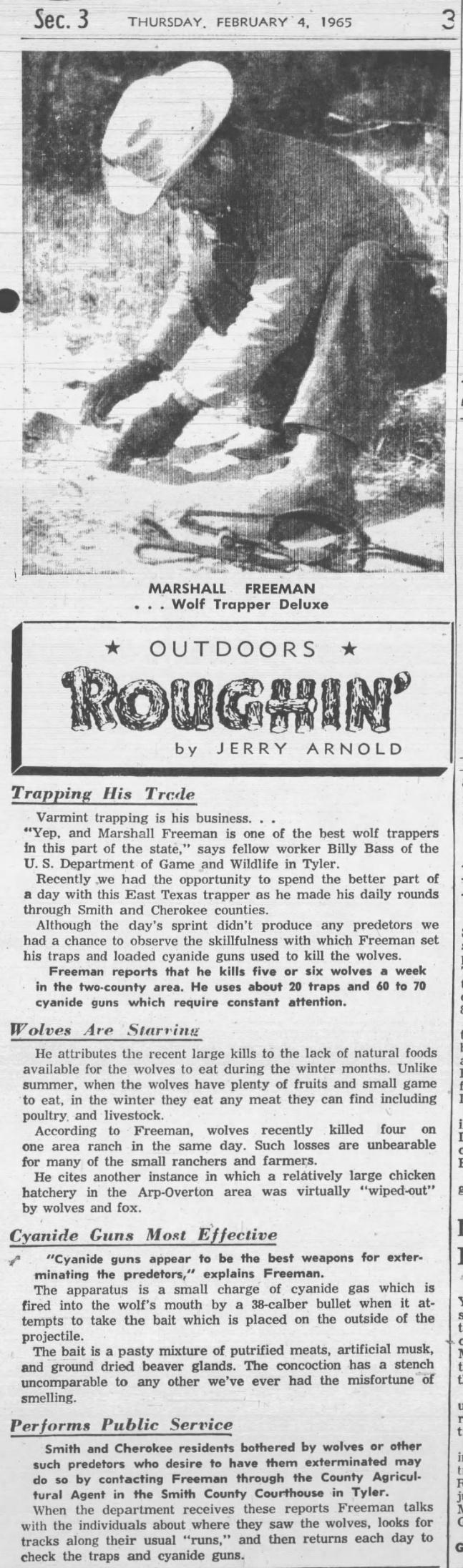
Marshall Freeman
In December, a short feature on the red wolf was written by W.R. Long, Information and Education Officer for the TPWD. In stark contrast to McCarley’s assertion that Canis rufus populations were in dire straits in the state, Long asserts, “Red wolves and coyotes are still doing fine, thank you. Typically larger than the coyote, normally greyish brown but occasionally blackish in color, the red wolf is difficult to distinguish from the coyote in the field. Many observations and sightings are recorded, but the biologist cannot rely on these for positive identification.”33 The motivations behind the publication of this errant report are unknown.
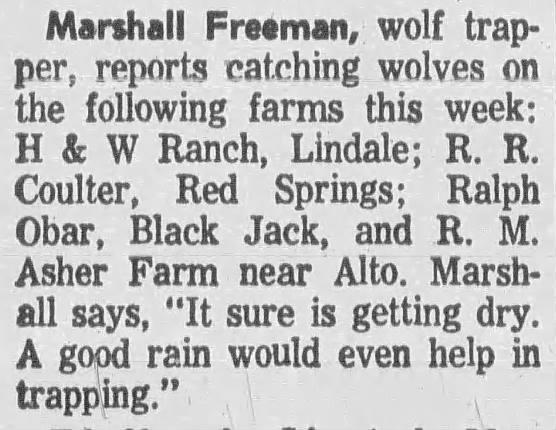
A typical work week for Marshall Freeman, included in “Browsing with Browning,” 1965.
Early in 1966, Freeman reported that in three years he had been working, he had “caught or killed 428 wolves.”34 One wonders what happened to the animals which were simply caught and not killed, and how Freeman made and articulated those decisions. While only averaging three to four animals per week, this is still a notable uptick in yearly averages for this program, indicating increased human-canid conflict in just the last few years. Without discounting Freeman’s commitment and obvious skillset… if the predator control program was so efficient, why were the “enemy” forces increasing? Though no non-standard animals have been found reported by the Smith-Cherokee government trapper that year, on December 21, Rusk County added another extraordinary data point for the non-standard canids: a photograph of a “Big Bad Wolf Slain” by civilian Dale Beckman of the Red Level community, tucked inside the northeast corner of the golden triangle. The Kilgore Herald article reports that the “50-pound timber wolf” was killed after Beckman “fought the large animal with [a] picket” and that “The wolf made a lunge at Beckman and he knocked his eye out the first swing with the picket.”35 Non-standard canid, indeed! The dark-colored animal is displayed hitched by the hind legs into the air, and though the canid is dark and blurry, this researcher thinks the eye in question can be seen dangling below its socket.
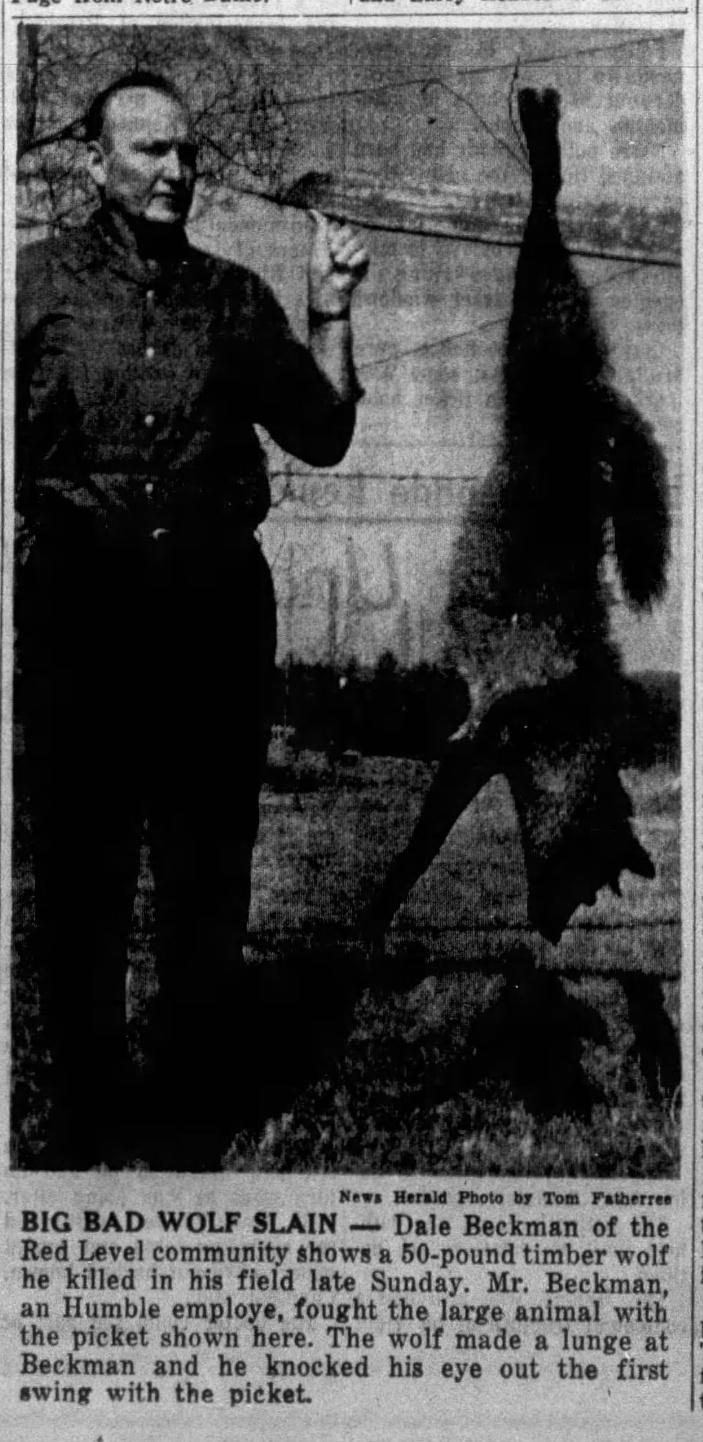
Civilian David(Dale?) Beckman, Red Level, Rusk County, 1966.
Though the first federal legal protections for Canis rufus were passed in the form of the Endangered Species Protections Act of 1966, the status and true nature of the beasts in East Texas remained obscured. By January 1967, Marshall Freeman was forced to admit that he was “spread too thin for effective work” in both counties, thus retreating from Cherokee County to bolster Smith’s defenses and breaking this historically and environmentally ambitious collaboration. The newspaper allowed some consolatory language, stating that the “cooperative program with Cherokee County… has been most satisfactory. The distance traveled and time consumed in travel made it necessary for Marshall to spend all of his time on hot spots. We are sure a more satisfactory program of control will result when his full efforts are given in Smith County.”36 A man named Roger Freeman, relationship unknown though strongly suspected, took over Marshall’s previous territory in Cherokee County. Even so, in December of 1967, one resident reported losing “a few calves to wolves. ‘They are running in packs now and are getting pretty brave,’ Jack [Boyles] said.”37
If you believe the newspapers, Marshall Freeman remained in the wolf trapper position until at least 1976, a clear indicator of the colloquial barriers to this research and his reliability in the position. The numbers don’t lie; He was a pretty dang good coyote trapper. Though the red wolf was declared entirely extinct in the wild in 1980, rumors persisted for years locally. One 1984 article harangues locals with the headline, “ETexas Ranchers Crying ‘Wolf’ Instead of Coyote.” It includes the scientific community’s classic diss tracks such as,
- “Farmers and ranchers swear they’ve seen them here. But wildlife biologists say that isn’t possible.”
- “As far as the farmers and ranchers are concerned, there are big, dog-like animals out there killing things. For all intents and purposes they are wolves.”
- And the eternally popular, “Although there may still be sightings in far East Texas…”
But buried in these old standard platitudes is a single unusual note of something dissonant among the ranks of scientists. The article briefly interviews TPWD biologist John Wallace, “who claims wolves and coyotes as a special interest, [and] speculates that East Texas coyotes may be larger than the species that originally came here as a result of their interbreeding with red wolves.” Of course, that would be absurd. The article continues to point out that “Other wildlife biologists don’t share his belief,” and quoting Austin Parks and Wildlife biologist Bruce Thompson as saying, “The likelihood is pretty far out.”38
However, in 2018, something “pretty far out” was found. A historic pocket of red wolf genetics was reported first on Galveston Island by a local named Ron Wooten, who stashed tissue samples from roadkill in his freezer for nigh on ten years before he was finally able to convince the powers that be to test the specimens. Since then, dedicated scientists and just plain enthusiastic locals have been working together to better understand and protect this extraordinary scientific opportunity, though admittedly with varying degrees of success and an open-ended future. How could such an extraordinary thing magically appear, right under our noses?
Though still classified under the coyote umbrella, expanded testing revealed another similar “reservoir for red wolf ancestry”39 along the Texas-Louisiana coast, and research on the unique Gulf Coast canid population in ongoing, though it has been established that (perhaps most importantly), the population exhibits “disproportionately larger ears relative to their head sizes when compared to coyotes, red wolves, and hybrids.”40 Pardoning the introgression of scientific citation systems, research published February 10, 2026 states:
The existence of red wolf-like alleles in the region’s coyote populations suggests that red wolf ancestry has naturally persisted in some isolated areas for ≥40 years through means not fully understood. Documentation of large-bodied Canis individuals in Louisiana (Giordano & Pace, 2000) and red wolf genetics in Canis populations along the Gulf Coast of Texas (Barneset al., 2022; Heppenheimer, Brzeski, et al., 2018; vonHoldt, Brzeski, et al., 2022) and Louisiana (Murphy et al., 2019;vonHoldt, Hinton, et al., 2022) indicates that genetic and/or phenotypic red wolf-like canids may persist in the region.41
Further, the researchers posit that “the coastal wetlands of Louisiana may exert unique, habitat-specific ecological pressures on canids in the region,” which influenced the region’s genetic variance when it came to things like size, mate selection, and access to preferred habitat.42 Double further, these unusual animals utilize habitat centered around large river floodplains, which “indicates that the floodplains of the Sabine River along the Texas–Louisiana border may provide a movement corridor, allowing some individuals to disperse from coastal wetlands in southwestern Louisiana into surrounding areas, particularly in the Big Thicket National Preserve in southeastern Texas, where other coyote metapopulations may persist, thereby maintaining some gene flow with adjacent inland populations.”43
Eight days after the Gulf Coast canid research was published, a news report from Longview highlighted unusual black “coyotes” caught on a game camera outside of Pine Tree, tucked in the northeastern-most corner of the inverted golden triangle in Gregg County, roughly twenty direct miles down the Sabine from Billy Bass’s “rare black wolf” of 1962.44 Though the photos are grainy, it appears that its companion is a “regular colored one,” whatever “it” is, or whatever “they” are. Though the glimpses are fleeting and fuzzy, speaking from a historical perspective, residents of the inverted golden triangle have clearly continued seeing something non-standard in the river bottoms of East Texas for generations.
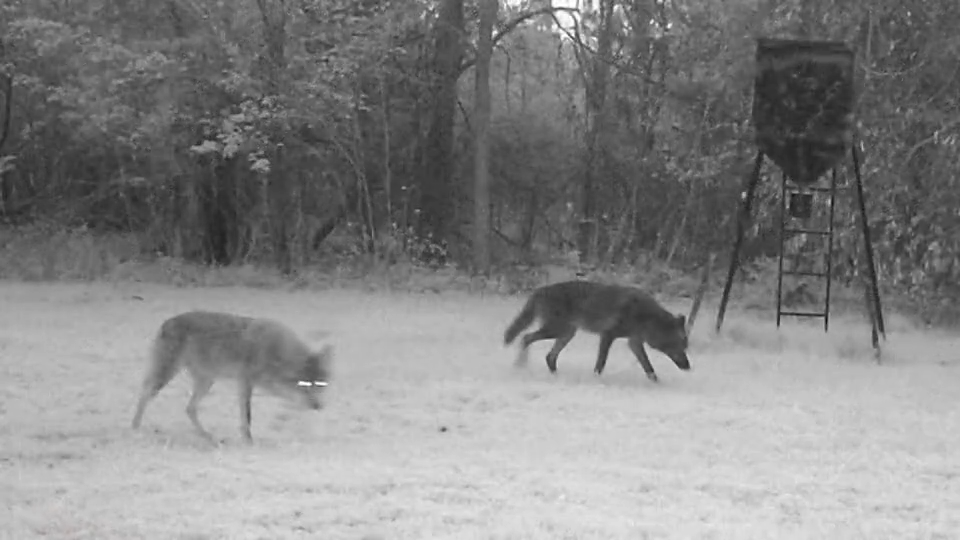
“Coyotes” Caught on a game camera near Pine Tree, February 2026.
Table 1. Populations
| Sq Miles | County | 1930 | 1940 | 1950 | 1960 | 1970 | 1980 | 1990 |
|---|---|---|---|---|---|---|---|---|
| 921 | Smith | 53123 | 69090 | 74701 | 86350 | 97096 | 128366 | 151309 |
| 1053 | Cherokee | 43180 | 43970 | 38694 | 33120 | 32008 | 38127 | 41049 |
| 842 | Van Zandt | 32315 | 31155 | 22593 | 19091 | 22155 | 31426 | 37944 |
| 873 | Henderson | 30583 | 31822 | 23405 | 21786 | 26466 | 42606 | 58543 |
| 1062 | Anderson | 34643 | 37092 | 31875 | 28162 | 27789 | 38381 | 48024 |
| 1237 | Houston | 30017 | 31137 | 22825 | 19376 | 17855 | 22299 | 21375 |
| 865 | Angelina | 27803 | 32201 | 36032 | 39814 | 49349 | 64172 | 69884 |
| 981 | Nacogdoches | 30290 | 35392 | 30326 | 28046 | 36362 | 46786 | 54753 |
| 938 | Rusk | 32484 | 51023 | 42348 | 36421 | 34102 | 41382 | 43735 |
| 276 | Gregg | 15778 | 58027 | 61258 | 69436 | 75929 | 99487 | 104948 |
| 593 | Upshur | 22297 | 26178 | 20822 | 19793 | 20976 | 28595 | 31370 |
| 645 | Wood | 24183 | 24360 | 21308 | 17653 | 18589 | 24697 | 29380 |
| 258 | Rains | 7114 | 7334 | 4266 | 2993 | 3752 | 4829 | 6715 |
Table 2. Lake Constructions, Golden Triangle
| Year | Lake | Acreage |
|---|---|---|
| 1948 | Cherokee | 3749 |
| 1949 | Tyler (West) | 2224 |
| 1957 | Jacksonville | 1320 |
| 1957 | Striker | 1863 |
| 1960 | Tawakoni | 37879 |
| 1962 | Palestine | 25560 |
| 1966 | Tyler East | 2276 |
| 1974 | Martin Creek | 4981 |
| 1980 | Lake Fork | 27,264 |
Lake Contructions, Peripheral Lakes
| Year | Lake | Acreage |
|---|---|---|
| 1951 | B.A. Steinhagen | 10687 |
| 1958 | Lake O’ the Pines | 19780 |
| 1962 | Athens | 1799 |
| 1965 | Cedar Creek | 32623 |
| 1965 | Sam Rayburn | 114500 |
| 1966 | Houston County | 1330 |
| 1967 | Toledo Bend | 181600 |
| 1976 | Nacogdoches | 2212 |
| 1987 | Richland Chambers | 41356 |
-
“Wolf Payments,” TMT, Thursday, July 21, 1960, Newspapers.com. ($169.05 Adjusted for inflation.) ↩︎
-
Jerry Arnold, “Outdoor Roughin’,” TMT, Thursday, February 4, 1965, Newspapers.com. ↩︎
-
Howard McCarley, “Taxonomic Status of Wild Canis (Canidae) in the South Central United States,” The Southwestern Naturalist, Vol. 7, No. 3/4 Dec 15, 1962, 234, https://doi.org/10.2307/3668845 ↩︎
-
McCarley, “Taxonomic Status,” 232. ↩︎
-
The springs, the author can’t speak for the smell of the humans. ↩︎
-
Steven R. Davis, “Rains County,” Handbook of Texas Online, Texas State Historical Association, Pub. 1952, Rev., Jan 14, 2021, https://www.tshaonline.org/handbook/entries/rains-county. ↩︎
-
Though the much larger projects of Lake Sam Rayburn (1965) and Toledo Bend (1967) are also extremely relevant to the species’ history, the mid-river regions experienced different human dynamics and socioeconomic conditions and deserve their own full analysis. ↩︎
-
“Chandler Comprehensive Plan,” Texas Engineering Extension Service, 2010: College Station, III-1. https://www.chandlertx.com/DocumentCenter/View/52/Chapter-3-Community-Profile?bidId=. ↩︎
-
Ben Browning, “Browsing with Browning,” TMT, Wednesday, May 8, 1963, Newspapers.com. ↩︎
-
Vicki Betts, “For the Citizens of East Texas: The Desegregation of Tyler State Park,” Chronicles of Smith County, Texas, 51, 2021, 2-9, http://hdl.handle.net/10950/4165. ↩︎
-
Browning, “Browsing,” TMT, Saturday, August 3, 1957, Newspapers.com. ↩︎
-
Bob Murdoch, “Farm & Ranch Topics: Smart Wolves,” TMT, Monday, November 26, 1956, Newspapers.com. ↩︎
-
“County To Make War on Wolves,” The Cherokeean (Rusk), Thursday, January 16, 1961, https://texashistory.unt.edu/ark:/67531/metapth150376/. ↩︎
-
“Sabine Decides to Poison Foxes,” TMT, Friday, February 6, 1959, Newspapers.com. ↩︎
-
“Sabine,” TMT. ↩︎
-
“Expenses for Election Over Smith Budget,” TMT, Thursday, February 2, 1961, Newspapers.com. ↩︎
-
“War on Wolves,” The Cherokeean. ↩︎
-
“Commissioners Name Cherokee Depositories,” TMT, Friday, February 17, 1961, Newspapers.com. (Roughly $33,000, adjusted for inflation, though the total salary for the trapper is unknown.) ↩︎
-
Browning, “Browsing,” TMT, Saturday, April 15, 1961, Newspapers.com. ↩︎
-
Browning, “Browsing,” TMT, Wednesday, August 23, 1961, Newspapers.com. ↩︎
-
Browning, “Browsing,” TMT, Friday, November 17, 1961. Newspapers.com. ↩︎
-
Browning, “Browsing,” TMT, Wednesday, January 10, 1962. Newspapers.com ↩︎
-
Joseph W. Hinton, Kyla M. West, Daniel J. Sullivan, Jacqueline L. Frair, and Michael J. Chamberlain, “The natural history and ecology of melanism in red wolf and coyote populations of the southeastern United Sates – evidence for Gloger’s rule,” BMC Zoology, June 2022. https://doi.org/10.1186/s40850-022-00138-5. ↩︎
-
Browning, “Browsing,” TMT, Saturday, April 14, 1962, Newspapers.com. ↩︎
-
“Commissioners Court Limits Wolf Trapper,” Cherokeean, Thursday, October 3, 1963, https://texashistory.unt.edu/ark:/67531/metapth150516/. ↩︎
-
“Commissioners,” Cherokeean. ↩︎
-
“Wolf Trapper Reinstated,” Cherokeean, Thursday, October 17, 1963, https://texashistory.unt.edu/ark:/67531/metapth150518/. ↩︎
-
Browning, “Browsing,” TMT, Thursday, April 25, 1963, Newspapers.com. ↩︎
-
“ET Farm, Ranch Club Meets Today,” TMT, Wednesday, August 21, 1963, Newspapers.com. ↩︎
-
Browning, “Browsing,” TMT, Sunday, February 9, 1964, Newspapers.com. ↩︎
-
Arnold, “Outdoors Roughin’,” TMT. ↩︎
-
W.R. Long, “East Texas Wildlife: The Red Wolf in Texas,” TMT, Thursday, December 23, 1965, Newspapers.com. ↩︎
-
Browning, “Browsin’,” TMT, Monday, March 14, 1966, Newspapers.com. ↩︎
-
“Big Bad Wolf Slain,” Kilgore Herald, Wednesday, December 21, 1966, Newspapers.com. ↩︎
-
Browning, “Browsing,” TMT, Friday, January 13, 1967, Newspapers.com. ↩︎
-
Browning, “Browsing,” TMT, Friday, December 8, 1967, Newspapers.com ↩︎
-
Doug Cosper, “ETexas Ranchers Crying ‘Wolf’ Instead Of Coyote,” Tyler Courier-Times, Sunday, January 1, 1984, Newspapers.com. ↩︎
-
Joey Hinton, Amy C. Shutt, Jazmin Murphy, Colleen O’Donnell, “Gulf Coast canids: A wetland coyote ecotype shaped by red wolf introgression,” Ecosphere, 2026, 16, https://doi.org/10.1002/ecs2.70529. ↩︎
-
Hinton, et al., “Gulf,” 8. ↩︎
-
Hinton, et al., “Gulf,” 3. ↩︎
-
Hinton, et al., “Gulf,” 3. ↩︎
-
Hinton, et al., “Gulf,” 14. ↩︎
-
Andrew Culver, “Increased coyote sightings in Longview lead to growing caution for public safety,” KLTV, Feb 18, 2026, https://www.kltv.com/2026/02/18/increased-coyote-sightings-longview-lead-growing-caution-public-safety/. ↩︎